-
 Tel:86-15176910262
-

Search
 Tel:86-15176910262
Search
Achieving high-precision metallurgical reactions in steelmaking requires more than just raw materials; it demands a sophisticated delivery system. Cored wire, a tubular steel sheath filled with specific metallurgical powders, has become the standard for desulfurization, deoxidation, and alloying due to its superior recovery rates compared to direct powder injection.
The production of this specialized wire requires a highly calibrated ERW (Electric Resistance Welding) tube forming system. Unlike standard piping, cored wire production must integrate precise powder dosing with seamless sealing to ensure that the internal chemicals remain stable during transport and subsequent melting in the ladle furnace.
For manufacturers looking to enter this niche, partnering with an experienced steel pipe making machine supplier is critical to balancing production speed with the strict tolerances required for metallurgical grade wire.


Cored wire production is essentially a specialized adaptation of the ERW tube mill process. It begins with low-carbon cold-rolled steel strips, which are uncoiled and flattened before being shaped into a U-profile. The unique challenge lies in the transition from a profile to a sealed tube, as the internal cavity must be filled with precisely formulated powders—such as Calcium, Aluminum, or Titanium—without compromising the structural integrity of the sheath.
The process requires an integrated control system where the powder feeding rate is synchronized perfectly with the line speed. Any deviation in the filling ratio (typically 10% to 35%) can lead to inconsistent metallurgical reactions in the final steel refining process, making the accuracy of the dosing system the heartbeat of the entire production line.
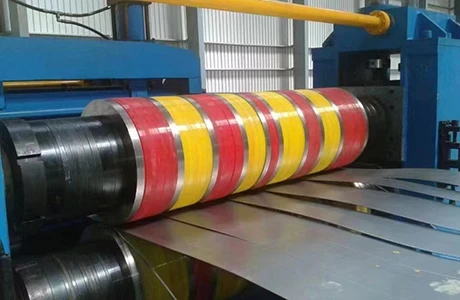
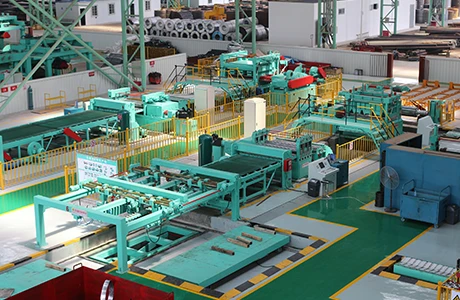
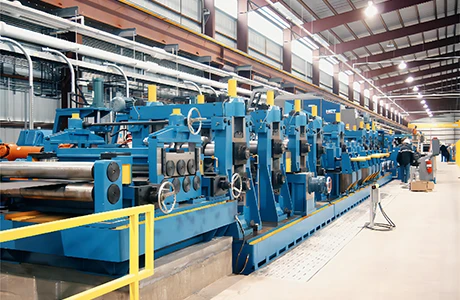
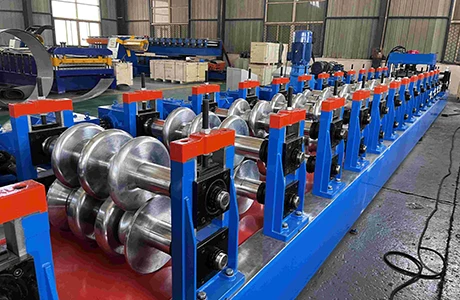
A comprehensive production line is composed of several interlinked modules. It starts with the entry section, involving a coil car and an uncoiler, followed by a strip flattener to remove coil set. The core is the precision roll forming section, which gradually transforms the strip into a tubular shape. For cored wire, this section must be designed to maintain an open profile long enough for the powder dosing system to operate effectively.
The welding unit is where the tube is sealed. Depending on the requirement, manufacturers use either mechanical closing or High-Frequency (HF) welding. HF welding is preferred for high-strength applications as it creates a robust longitudinal seam that prevents powder leakage during long-distance wire feeding into the ladle. Solid-state HF welders are often employed to ensure consistent heat distribution and seam quality.
The final stages involve precision sizing, cooling, and straightening. Given that cored wire is often delivered in large coils or drums, the winding system must be capable of handling high tension without distorting the wire's outer diameter, which typically ranges from Φ9 to Φ20 mm.
The most critical failure point in cored wire production is the "powder-to-seal" transition. If the powder is filled too densely, it can interfere with the welding process, leading to seam porosity or "blow-outs." Conversely, under-filling results in a loss of metallurgical efficiency.
The technical success of a cored wire line depends on the synchronization between the PLC-controlled powder dosing system and the HF welding unit, ensuring a filling accuracy of ±1.5% while maintaining a leak-proof seal.
To mitigate these risks, advanced lines utilize automated online inspection systems. These systems monitor the wire's outer diameter and the consistency of the powder distribution in real-time. By adjusting the feed rate dynamically based on line speed, manufacturers can maintain a stable production speed of up to 120 m/min.
When evaluating a cored wire production system, the focus shifts from simple output volume to "process stability." Key performance indicators include the powder filling consistency, the mechanical strength of the welded seam, and the surface smoothness of the finished wire. A smooth outer surface is essential to prevent snagging during the high-speed feeding process in a steel mill.
Comparing different technical priorities reveals where the value lies. While speed is important, the precision of the powder filling ratio and the reliability of the sealing method have a more direct impact on the end-user's metallurgical recovery rates.
Cored wires are indispensable in secondary steel refining. In a typical ladle furnace (LF) setting, Calcium wire is injected to promote desulfurization and deoxidation, while Aluminum or Titanium wires are used for precise alloy addition. The ability of the wire to melt rapidly and release its powder uniformly ensures that the molten steel reaches the required cleanliness and stability levels before continuous casting.
The versatility of the production line allows for the manufacturing of various types of cored wires, including flux and compound alloy varieties. This flexibility is crucial for special steel producers who must frequently adjust their chemical formulations to meet varying international standards for automotive or aerospace grade steel.
The transition from manual powder filling to fully automated PLC-controlled systems has drastically reduced waste and improved safety. Early production methods struggled with powder leakage and inconsistent filling, which often led to unstable chemical reactions during the refining process.
Modern systems now integrate CNC-milled rollers and heat-treated gears to ensure that the mechanical stress on the thin-walled steel strip (0.3 – 0.6 mm) is minimized. This reduces the occurrence of surface scratches and ensures that the structural integrity of the sheath is maintained throughout the forming process.
Furthermore, the adoption of solid-state HF welding has allowed for faster production speeds without sacrificing the quality of the seam. This evolution has enabled a broader range of wire diameters to be produced on a single line, increasing the operational efficiency for the manufacturer.
Selecting the right machinery requires a focus on the interplay between the dosing system and the welding unit. A buyer must consider not just the maximum speed, but the minimum achievable powder filling error and the ability of the line to handle different powder densities without clogging.
Another critical factor is the longevity of the rollers and the stability of the drive system. In high-volume environments, wear-resistant rollers and precision-milled key grooves are essential to prevent dimensional drift over time, which would otherwise lead to rejects in the final wire coil.
The following framework provides a qualitative comparison of the key technical considerations when selecting a production line based on the intended output quality.
| Evaluation Factor | Standard Requirement | High-Precision Requirement | Operational Impact |
|---|---|---|---|
| Powder Filling Accuracy | ±3.0% to ±5.0% | ±1.5% or better | Reaction Consistency |
| Sealing Method | Mechanical Closing | HF Welding | Leakage Prevention |
| Strip Thickness Range | 0.4 - 0.8 mm | 0.3 - 0.6 mm | Sheath Weight/Recovery |
| Control System | Semi-Automatic | Full PLC Automation | Process Repeatability |
| Roller Material | Standard Hardened Steel | CNC Milled / Carburized | Surface Quality/Lifespan |
| Max Line Speed | 60 - 80 m/min | Up to 120 m/min | Production Throughput |
A cored wire is a specialized tubular product consisting of a low-carbon steel sheath that encapsulates a precise amount of metallurgical powder. Unlike solid wires, it is designed to melt in a molten steel bath, releasing the powder for reactions like desulfurization or alloying. This method is far more efficient than direct powder addition, as it prevents powder loss and provides a controlled release of additives.
High-Frequency (HF) welding creates a fusion bond that is significantly stronger and more airtight than mechanical closing. In cored wire production, the seal must be absolute to prevent the fine metallurgical powders from leaking during transport or while being fed through long delivery systems into the furnace. HF welding ensures the seam can withstand the mechanical tension of winding and unwinding.
Filling is managed via a PLC-controlled dosing system that synchronizes the powder feed rate with the real-time speed of the roll forming line. Using high-precision feeders and sensors, the system adjusts the volume of powder injected into the U-profile before it is closed. This allows manufacturers to maintain a filling ratio between 10% and 35% with a typical accuracy of ±1.5%.
The sheath is typically made from low-carbon cold-rolled steel strips with a thickness between 0.3 and 0.6 mm. Low carbon is essential because the sheath must melt quickly and completely in the molten steel without introducing unwanted carbon or impurities that could contaminate the refine grade of the steel being processed.
Yes, provided the dosing system is designed for versatility. Since the primary difference between Calcium, Aluminum, or Titanium wires is the powder formulation, the same ERW tube mill can be used. However, the powder feeder may need calibration for different powder densities and flow characteristics to ensure the filling ratio remains consistent.
Surface defects are usually caused by worn-out rollers, improper lubrication, or misalignment in the sizing section. Because the steel strip used is very thin, any irregularity in the roller surface or debris in the forming section can cause scratches or indentations. Using CNC-milled, heat-treated rollers significantly reduces this risk and extends the equipment's life.
The production of metallurgical cored wire is a precision-driven exercise in ERW tube forming. By integrating high-accuracy powder dosing with robust HF welding, manufacturers can provide the steel industry with the essential tools needed for high-purity refining. The shift toward full automation and CNC precision ensures that these wires meet the stringent requirements of modern metallurgy.
Investing in a system that prioritizes filling accuracy and seam integrity over raw speed is the most sustainable path for those seeking to deliver high-value metallurgical products. As steel cleanliness standards continue to rise, the role of high-precision cored wire production will only become more critical.

Send a Message
Dear customer, thank you for your attention! We provide high-quality machinery and equipment and look forward to your orders. Please inform us of your needs and we will respond quickly!