A Smarter, More Flexible Solution for Automatic Steel Tube Bundling
As steel tube manufacturers continue to improve production efficiency and factory automation, the requirements for automatic pipe stacking and bundling systems are changing.
Traditional fork-type stacking machines are widely used in steel tube mills, but their operating noise can be significant. Electromagnetic stacking systems offer another solution, yet their multiple servo motors, controllers, and coordinated movements can make maintenance more complicated.
HEBEI AIS MACHINERY introduces a robotic steel tube stacking machine that provides a modern alternative to traditional fork-type and electromagnetic stacking systems.
Instead of relying on mechanical forks or a large electromagnetic stacking structure, this system uses one or more industrial robots to pick up and arrange steel tubes into neat bundles.
With a simple chain conveyor for tube feeding, a flexible robotic layout, and straightforward operation, the system helps steel tube manufacturers achieve efficient automatic stacking with less structural obstruction and easier maintenance management.
The robotic stacking machine can also be integrated with an automatic strapping machine to create a complete automatic steel tube bundling and packing line.

1. What Is a Robotic Steel Tube Stacking Machine?
A robotic steel tube stacking machine is an automatic handling system designed to collect, lift, arrange, and stack finished steel tubes into bundles according to a preset stacking pattern.
It uses industrial robots equipped with suitable gripping tools instead of traditional mechanical forks or electromagnetic lifting mechanisms.
After the finished tubes are transferred to the feeding position, the robot grips a predetermined quantity of tubes and places them in the required position. This process repeats until the specified bundle configuration is completed.
The system can be configured for different tube dimensions, bundle sizes, stacking patterns, and factory layouts, depending on the customer's production requirements.
Typical applications include:
Whether you are upgrading an existing tube mill or planning a new production facility, a robotic tube stacking system offers a flexible solution for modernizing the finished-product handling process.

2. How Does the Robotic Tube Stacking System Work?
The robotic stacking system follows a straightforward operating sequence.
Step 1: Automatic Tube Feeding
Finished steel tubes are transferred to the stacking area by a chain conveyor or another suitable feeding mechanism.
The simple feeding arrangement reduces the need for a large overhead stacking structure and can be adapted to the available factory space.
Step 2: Tube Positioning and Gripping
The tubes are positioned for robotic pickup. Depending on the system configuration, sensors, positioning devices, or other control components ensure that the tubes are presented correctly.
The robot uses a dedicated gripping tool designed for the specified tube dimensions, weight, and surface requirements.
Step 3: Robotic Lifting and Stacking
The robot picks up the tubes and places them in the programmed stacking position.
The stacking sequence is controlled according to the required bundle pattern, helping achieve consistent and orderly tube arrangement.
For applications requiring higher throughput, multiple robots can be considered to increase handling capacity, subject to cycle-time calculations and the overall line configuration.
Step 4: Bundle Completion
The robot continues picking and placing tubes until the required quantity or stacking pattern is reached.
The completed bundle is then transferred to the next station according to the configured handling process.
Step 5: Automatic Strapping
For a complete packing solution, the robotic stacking machine can be connected to an automatic steel tube strapping machine.
The completed bundle is transferred to the strapping station, where the strapping machine secures the tubes for storage, handling, and shipment.
The result is an integrated tube stacking and bundling solution that reduces manual handling and improves packaging consistency.

3. Key Advantages of the Robotic Steel Tube Stacking Machine
3.1 Lower Operating Noise
Fork-type stacking machines rely on mechanical lifting and fork movements that can generate considerable impact noise during operation.
A robotic stacking system eliminates the traditional fork-based stacking mechanism. With a properly designed gripping tool and motion program, tube handling can be smoother and quieter.
Actual noise levels depend on the robot, gripping method, tube contact, conveyor, and operating conditions.
3.2 Simpler Maintenance Management
Electromagnetic stacking systems may require several servo motors, drives, controllers, and coordinated motion axes. A fault in one component can interrupt the stacking process.
A robotic system consolidates the main pickup and placement movements into an industrial robot and its control system.
This can simplify the overall motion architecture and reduce the number of separate coordinated mechanisms compared with some traditional designs.
Industrial robots still require routine inspections, lubrication, and maintenance according to the manufacturer's recommendations. However, their integrated control architecture can make maintenance management more straightforward.
3.3 No Large Overhead Stacking Bridge
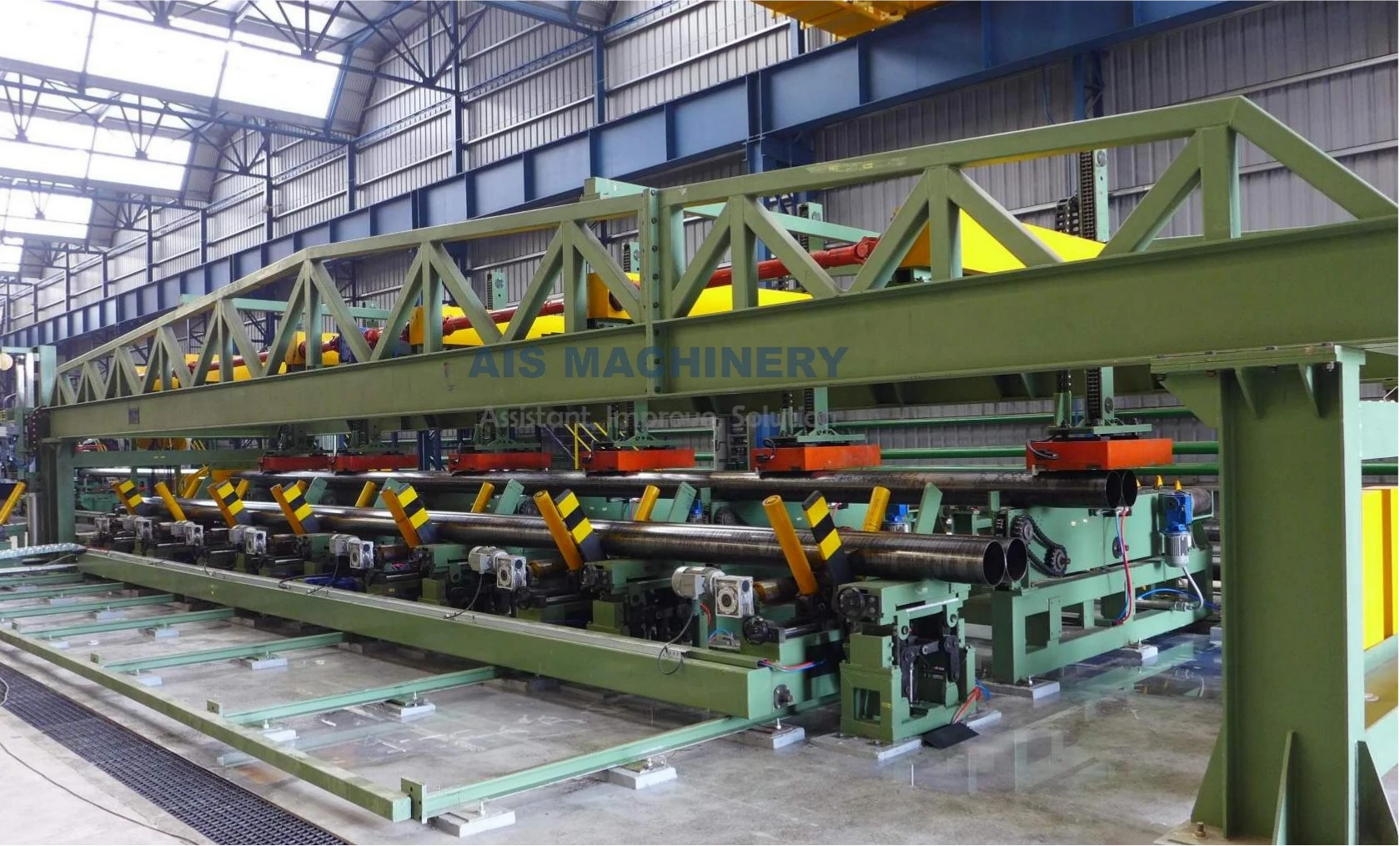
Traditional electromagnetic stacking systems often use a large bridge-type frame to support lifting and movement mechanisms.
Depending on the design, this structure can occupy considerable vertical space and obstruct the operator's view of the production area.
A robotic stacking system can use a more compact layout without the same type of large overhead bridge, improving visibility and making the stacking area feel more open.
The actual footprint and clearance requirements depend on the robot's reach, safety guarding, and factory layout.
3.4 Fast and Consistent Stacking
Industrial robots can perform repetitive pickup and placement movements according to programmed trajectories.
Once the system has been properly commissioned and its cycle time has been verified, it can deliver consistent stacking performance with reduced dependence on manual handling.
For higher-capacity production lines, AIS MACHINERY can evaluate whether a single-robot or multiple-robot configuration is more suitable.
The achievable throughput depends on tube length, weight, dimensions, gripping quantity, stacking pattern, robot cycle time, and downstream equipment capacity.
3.5 Flexible Configuration
A robotic system can be configured around different tube sizes, stacking patterns, and production requirements.
Depending on the gripping tool and control configuration, product changes can be managed through programmed recipes and appropriate tooling adjustments.
This flexibility makes robotic stacking particularly attractive to manufacturers producing multiple tube sizes or different product specifications.
3.6 Competitive Investment Cost
Advanced automation does not always require a dramatically higher investment.
Based on AIS MACHINERY's current configuration and quotation experience, the robotic stacking solution can cost less than 30% more than a comparable electromagnetic stacking system.
The actual price difference depends on the number of robots, payload requirements, gripping tooling, safety systems, and line configuration.
Considering maintenance requirements, production continuity, factory visibility, and automation flexibility, a robotic system may offer attractive long-term value for steel tube manufacturers.
3.7 Easy Integration with Automatic Strapping
Robotic stacking is only one part of an efficient tube packing process.
When integrated with an automatic strapping machine, the system can automatically arrange the tubes and secure the finished bundles, creating a more complete packaging solution.
AIS MACHINERY can evaluate the stacking and strapping equipment together to improve line coordination and reduce manual intervention.
Steel tube manufacturers commonly consider three solutions for automatic stacking and bundling. Each has its own advantages, and the best choice depends on production requirements and investment priorities.
| Comparison | Fork-Type Stacking | Electromagnetic Stacking | Robotic Stacking |
|---|
| Stacking method | Mechanical forks | Electromagnetic lifting and coordinated movements | Industrial robot with dedicated gripping tool |
| Operating noise | Can be relatively high | Depends on the mechanical and lifting design | Can be reduced through controlled robotic handling |
| Mechanical structure | Fork mechanisms and supporting frame | Often uses a large bridge-type structure | Flexible robotic layout |
| Factory visibility | Depends on frame design | Large overhead structure may obstruct visibility | Can eliminate the traditional large bridge structure |
| Motion control | Mechanical and electrical control | Multiple coordinated servo axes may be used | Integrated robot motion control |
| Maintenance | Fork mechanisms require inspection and maintenance | Multiple coordinated components may increase troubleshooting complexity | Robot and gripping tool require routine maintenance |
| Product flexibility | Depends on fork and stacking design | Depends on lifting arrangement and control system | Flexible with suitable tooling and programming |
| Automatic strapping integration | Possible | Possible | Possible |
| Initial investment | Depends on design | Depends on configuration | AIS robotic configuration can be less than 30% more than a comparable electromagnetic system |
| Best suited for | Applications prioritizing a conventional stacking solution | Applications suited to electromagnetic handling | Applications prioritizing flexible automation and a more open layout |
Which system should you choose?
- Choose a fork-type system if a conventional mechanical solution meets your requirements and its operating characteristics are acceptable.
- Choose an electromagnetic system if its lifting method and configuration suit your products and production process.
- Consider robotic stacking if you want a flexible handling solution, a more open factory layout, and an alternative to multiple coordinated stacking mechanisms.
The right solution should be selected based on tube specifications, production speed, bundle requirements, maintenance resources, and total investment—not simply the equipment price.


5. Technical Configuration and Customization
The robotic steel tube stacking machine is engineered according to the customer's actual production requirements.
Key design considerations include:
Tube specifications
- Round, square, and rectangular steel tubes
- Tube diameter and cross-sectional dimensions
- Wall thickness and tube length
- Individual tube weight and surface condition
Stacking requirements
- Required quantity per bundle
- Bundle dimensions and stacking pattern
- Tube orientation and arrangement
- Gripping quantity per robot cycle
Production requirements
- Target stacking throughput
- Upstream tube mill output
- Downstream strapping capacity
- Required level of automation
Factory layout
- Available floor space and ceiling height
- Conveyor direction and transfer distance
- Robot working range and safety zone
- Connection with existing or new packaging equipment
AIS MACHINERY can evaluate these factors to develop a suitable robotic stacking and automatic bundling solution.
6. Complete Automatic Steel Tube Packing Line
For customers seeking a complete packaging solution, the robotic stacking machine can be integrated with other handling and packing equipment.
A typical process is:
Finished Tube Output → Chain Feeding Conveyor → Robotic Tube Stacking → Bundle Transfer → Automatic Strapping → Finished Bundle Discharge
The exact arrangement depends on the tube mill configuration and the customer's factory layout.
An integrated system can help reduce manual handling, improve bundle consistency, and coordinate the stacking and strapping processes more effectively.
AIS MACHINERY provides steel tube mill equipment and downstream handling solutions, helping customers evaluate the packaging process as part of their overall production line.
7. Frequently Asked Questions (FAQ)
Q1: What is the difference between robotic stacking and electromagnetic tube stacking?
Electromagnetic stacking uses electromagnetic lifting equipment and a coordinated movement system to handle steel tubes. Robotic stacking uses an industrial robot and a dedicated gripping tool.
The robotic approach can offer a more flexible layout and an alternative to multiple coordinated servo mechanisms. The suitability of either solution depends on tube specifications, handling requirements, and production capacity.
Q2: Is a robotic steel tube stacking machine suitable for round and square tubes?
Yes. The system can be designed for round, square, and rectangular steel tubes, provided the gripping tool, robot payload, and stacking program are suitable for the specified products.
The tube dimensions and weight range should be confirmed during technical evaluation.
Q3: Can one robot handle different tube sizes?
A robot may handle multiple tube sizes when its payload, reach, gripping tool, and control program support the required range.
Some applications may require adjustable gripping devices, interchangeable tooling, or different programmed stacking recipes. The final arrangement depends on the product range.
Q4: Is robotic stacking faster than traditional stacking systems?
Robotic stacking can provide fast and repeatable handling, but the achievable throughput depends on the application.
Tube length, weight, number of tubes per pickup, stacking pattern, robot cycle time, and conveyor speed all affect the final production rate. AIS MACHINERY evaluates these factors before recommending a configuration.
Q5: Does a robotic tube stacking machine require maintenance?
Yes. Like all industrial automation equipment, a robotic stacking system requires routine inspection and maintenance.
Typical tasks include checking the gripping tool, inspecting mechanical connections, maintaining the robot according to its manufacturer's instructions, and checking sensors and safety devices.
Its integrated motion control can simplify some aspects of maintenance compared with systems containing numerous separately coordinated mechanisms.
Q6: Is robotic stacking significantly more expensive than electromagnetic stacking?
Not necessarily. Based on AIS MACHINERY's current configuration and quotation experience, a robotic solution can cost less than 30% more than a comparable electromagnetic stacking system.
The actual investment depends on the number of robots, payload, gripping tooling, safety requirements, and overall line configuration.
Q7: Can the robotic stacking machine be connected to an automatic strapping machine?
Yes. The robotic stacking machine can be integrated with an automatic strapping machine to create a complete steel tube stacking and bundling line.
The transfer method, bundle positioning, and control signals must be coordinated to ensure that both machines operate efficiently.
Q8: Can AIS MACHINERY supply a complete automatic pipe bundling line?
AIS MACHINERY can evaluate and supply a configured solution covering robotic stacking, tube transfer, and automatic strapping, subject to the customer's technical requirements.
Please provide your tube specifications, production speed, bundle dimensions, and factory layout so we can recommend a suitable arrangement.
Q9: What information is required for a quotation?
To prepare a suitable technical proposal and quotation, please provide:
- Tube shapes, dimensions, wall thickness, and lengths
- Maximum individual tube weight
- Required stacking pattern and bundle size
- Target production speed
- Required level of automatic operation
- Factory layout drawing, if available
- Whether an automatic strapping machine is required
With this information, AIS MACHINERY can evaluate the robot configuration, gripping method, conveyor arrangement, and integration requirements.
8. Why Choose AIS MACHINERY?
HEBEI AIS MACHINERY provides steel tube production equipment and integrated solutions for tube manufacturers.
Our approach is to evaluate the complete production and packaging process rather than selecting stacking equipment in isolation.
For robotic steel tube stacking projects, we focus on:
- A practical configuration matched to the customer's tube specifications
- Integration with upstream tube mills and downstream strapping equipment
- Efficient tube handling and consistent bundle formation
- A layout that considers factory visibility and available space
- A balanced approach to investment cost, production efficiency, and maintenance
Whether you are building a new steel tube factory or upgrading an existing packaging line, AIS MACHINERY can help evaluate a suitable robotic stacking solution for your application.
Request a Robotic Steel Tube Stacking Solution
Looking for an alternative to traditional fork-type or electromagnetic stacking systems?
Contact HEBEI AIS MACHINERY to discuss your steel tube specifications, production capacity, and automatic bundling requirements.
Send us your tube size range, required bundle dimensions, target production speed, and factory layout. Our team will evaluate the appropriate robotic stacking configuration and automatic strapping solution for your project.
HEBEI AIS MACHINERY — Assistance · Integrated Solutions · Support.

 Tel:86-15176910262











 English
 Albanian
 Arabic
 French
 German
 Indonesian
 Italian
 Japanese
 Kazakh
 Korean
 Latin
 Macedonian
 Portuguese
 Russian
 Spanish
 Thai
 Turkish
 Ukrainian
 Uzbek