
-
 Tel:86-15176910262
-

Search

Choosing a Flying Cold Saw: Working Requirements and Integration Fit
Oct . 28, 2026 00:05
THE BUYER'S GUIDE / SELECTION
Choosing a Flying Cold Saw: Working Requirements and Integration Fit
A flying cold saw is a precision cut-off system installed at the end of a welded pipe production line. Before specifying one, buyers must evaluate pipe geometry, material grade, line speed, cut quality tolerance, and downstream finishing requirements. This guide draws on confirmed product data from HEBEI AIS MACHINERY EQUIPMENT CO.,LTD to explain the key selection criteria and to identify when a cold cutting flying saw machine is the right fit — and when a friction saw may be the better choice.
Pipe specification (diameter, profile, wall thickness, and material grade): confirm the production range falls within the machine's design envelope — round Φ50–168 mm, square 40–150 mm, rectangular up to 200×100 mm, wall 2–6 mm, carbon and high-strength steel — before selecting blade type and clamping force.
Production line speed and cut quality: verify that the required line speed (up to 120 m/min) and cut-end finish standard (burr-free, servo-controlled length) match the cold cutting configuration; if the line runs heavy-section carbon-steel structural pipe at high throughput with standard tolerance, a friction saw may be more appropriate.
Control system integration and clamping method: confirm Siemens PLC protocol compatibility with the existing mill master control and that hydraulic clamping cycle time is consistent with the target cut rate and reset interval.
What Is a Flying Cold Saw?
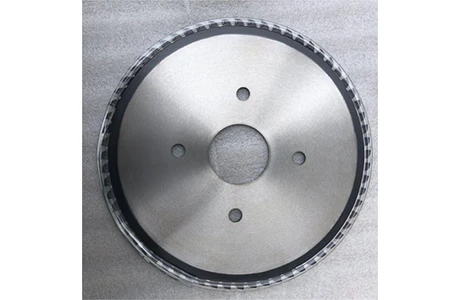
A flying cold saw is an online, synchronised cut-off machine that travels with the pipe at line speed, makes a precise cut, and then resets quickly for the next cycle. Unlike a hot-cut (friction) saw, it uses a low-speed, high-torque spindle with an HSS or TCT circular blade that generates minimal heat during the cut. The result is a flat, burr-free pipe end that typically requires little or no post-processing.
On a straight-seam (ERW) welded pipe production line, the cold cutting saw is the last process station. Because it directly determines pipe-end quality and cut-length accuracy, the choice of saw model has a significant knock-on effect on downstream handling, inspection, and packaging efficiency.
Key Selection Criteria
1. Pipe Specification: Diameter, Wall Thickness, and Profile
The primary sizing constraint is the range of pipe diameters and cross-sections the saw must handle. Based on confirmed product data for the Cold Cutting Flying Saw Machine, the typical design envelope covers:
- Round pipe: Φ 50 mm – Φ 168 mm
- Square section: 40 × 40 mm – 150 × 150 mm
- Rectangular section: up to 200 × 100 mm
- Wall thickness: 2 – 6 mm
- Material: carbon steel, high-strength steel
If your production includes stainless steel or alloy steel, the cold cutting configuration is still appropriate — confirmed comparison data notes that the cold saw is suitable for carbon steel, stainless steel, and alloy steel, whereas the friction saw is limited to carbon steel. For wall thicknesses beyond 10 mm in heavy-section carbon steel, the friction saw may be a more practical option.
Buyer tip: Confirm the full product mix — including future pipe grades — before finalising blade type and clamping force. A mismatch between blade specification and material hardness reduces blade life significantly.
2. Production Line Speed
A flying cold saw must be able to accelerate, synchronise, cut, and reset within the time window set by the line speed. The Cold Cutting Flying Saw Machine supports a maximum line speed of 50 – 120 m/min, driven by a servo motor for precise tracking. The servo-plus-encoder feed system controls cut-to-length directly, so positional accuracy is maintained across the full speed range.
Compare this against the friction saw range of 60 – 120 m/min. For very high-speed carbon-steel structural pipe lines that do not require burr-free ends, a friction saw may be the higher-throughput choice. For mixed-grade or precision lines, the cold cutting configuration is generally preferred.
3. Cut Quality and Length Tolerance
Cut quality requirements are often set by the end market or customer specification:
| Requirement | Cold Cutting Flying Saw | Friction Saw |
|---|---|---|
| Surface finish | Smooth and flat, minimal burrs | May require post-processing |
| Length tolerance | High precision (servo-controlled) | ±3 mm (standard) |
| Heat-affected zone | Minimal | Moderate |
| Post-processing needed | Rarely | Sometimes |
For automotive tubing, precision pipe, and export-grade pipe, confirmed data identifies the cold saw as the preferred technology. For structural pipes, scaffolding, and fluid tubes produced in large volumes at moderate quality tolerance, a friction saw may reduce operating cost.
4. Control System and Operator Interface
The confirmed product specification lists a Siemens PLC with encoder for cut-to-length control and a servo motor for the feed axis. The touchscreen HMI is described as having a friendly touch operation interface with clearer and simpler control, providing richer information and enabling operators to achieve consistent cut results through straightforward parameter entry.
Buyers integrating the saw into an existing pipe mill should verify PLC protocol compatibility with the mill's master control system. Siemens PLC is a widely adopted platform across ERW tube mill configurations, which typically simplifies integration.
5. Saw Blade Selection
The Cold Cutting Flying Saw Machine accepts two blade types:
- HSS (High-Speed Steel) blades — diameter range 350 – 650 mm; suited to general carbon and structural steel.
- TCT (Tungsten Carbide Tipped) blades — same diameter range; suited to harder materials and where longer blade life is required.
Confirmed comparison data indicates TCT blades deliver 1,000 – 2,000+ cuts per blade, compared to 200 – 600 cuts for HSS friction blades used in a friction saw. Blade cost per metre of cut and replacement frequency are therefore important total-cost considerations when selecting between cold and friction saw configurations.
6. Clamping Method
The Cold Cutting Flying Saw Machine uses hydraulic clamping. Hydraulic clamping provides consistent grip force needed for clean cuts across varying wall thicknesses, and is standard practice for precision cold cutting applications. Buyers operating at high throughput should verify that the hydraulic system cycle time is compatible with the target cut rate per minute.
7. Synchronisation and Reset Logic
The machine's microcomputer-controlled drive moves the saw carriage via a gearbox-and-rack mechanism through three phases:
- Determine the fixed-length cut position and accelerate to match line speed.
- Synchronise the carriage with the pipe and execute the cut.
- Reset the carriage rapidly for the next cycle.
Quick reset capability directly limits the minimum cut-to-cut length at a given line speed. Buyers should confirm that the reset time is consistent with the shortest pipe length in their production schedule.
Integration with the Pipe Mill Line
The flying cold saw is the final station of the tube mill finishing section. HEBEI AIS MACHINERY EQUIPMENT CO.,LTD offers a complete range of finishing-section equipment that precedes or follows the saw, including eddy current testing, seam annealing, straightening, chamfering and end-facing, hydro testing, threading, painting and oiling, and automatic bundling and packaging. Selecting equipment from a coordinated system reduces interface engineering and simplifies spare-parts management.
On the entry side, the ERW tube mill line includes un-coilers, flattening machines, shearer-and-butt-welders, and accumulators. The cold cutting saw receives pipe at line speed from the forming and welding sections; line speed consistency upstream directly affects cut-length accuracy at the saw.
Cold Cutting Flying Saw vs. Friction Flying Saw: When to Choose Each
The two flying saw technologies serve different production profiles. The table below summarises the confirmed comparison:
| Decision Factor | Flying Cold Saw | Friction Flying Saw |
|---|---|---|
| Material | Carbon, stainless, alloy steel | Carbon steel only |
| Cut finish | Burr-free, minimal finishing | May need deburring |
| Precision | High (servo-controlled) | ±3 mm standard |
| Blade life | Longer (TCT: 1,000–2,000+ cuts) | Shorter (200–600 cuts) |
| Noise | Low | Higher |
| Sparks | None | Generates sparks |
| Best application | Precision, export-grade, mixed grades | High-speed structural carbon steel |
For buyers producing precision tubing for automotive, export, or specification-grade markets, the cold cutting flying saw is the appropriate selection. For buyers maximising throughput on structural carbon-steel lines where cut-end cosmetics are secondary, a friction saw may offer a lower capital outlay.
Summary: Confirming Fit Before Purchase
Before specifying a flying cold saw, confirm the following against your production requirements:
- Pipe diameter and profile fall within the supported range.
- Wall thickness is within 2 – 6 mm (confirm for materials at or above high-strength steel grade).
- Required line speed is within the servo-drive capability.
- Cut-length tolerance and surface finish match downstream customer requirements.
- PLC control platform is compatible with your existing mill controls.
- Blade type (HSS or TCT) is matched to material grade and blade-cost targets.
When these criteria are met, the Cold Cutting Flying Saw Machine from HEBEI AIS MACHINERY EQUIPMENT CO.,LTD provides a well-documented, servo-controlled cut-off solution for ERW pipe production lines across round, square, and rectangular pipe profiles.
THE PEOPLE

About the author
THE COMPANY
HEBEI AIS MACHINERY EQUIPMENT CO.,LTD
Hebei AIS Machinery Equipment located in Shijiazhuang city, Hebei Province, China CN.Factory have passed the certification of ISO, CE and SGS which is a professional supplier of ERW Tube Mill Machine, High-Frequency Longitudinal Welded Pipe Making Machine, API Pipe Mill, FFX Induction Welding Pipe Making Machine, DFT Direct Forming to Square Pipe Mill, Cold Roll Forming Machine, Multi-functional Tube Mill Machine , Steel Coil Slitting line, Cut to Length Line and other Spare Parts.…
About Us ↗Visit company website ↗YOUR NEXT STEP
Bring your brief. Start a useful conversation.
Use case, specification, quantity and delivery window: make the next conversation specific.

Related Products






Related News

2026-11-02 02:23:25
ERW Pipe Mill for Sale: Buyer FAQs for a 76 mm Line
Review the 21.3 mm to 76 mm range, materials, equipment, speed, power, cutting methods, and production controls for an ERW pipe mill for sale.

2026-10-29 00:44:48
High-Speed Steel Coil Slitting Line FAQ: Specifications, Ordering and Support Questions
Get direct answers about High-Speed Steel Coil Slitting Line specifications, material compatibility, component layout, process steps, quality standards, and after-sales support from HEBEI AIS MACHINERY EQUIPMENT CO.,LTD.

2026-10-28 00:06:34
Learn the key working requirements and integration criteria for selecting a steel pipe making machine manufacturer. Covers diameter range, wall thickness, strip grade, HF welding power, footprint, and electrical supply using the 10inch 273mm ERW Pipe Making Machine from HEBEI AIS MACHINERY EQUIPMENT CO.,LTD.

2026-10-28 00:05:55
Choosing a Flying Cold Saw: Working Requirements and Integration Fit
Learn the key selection criteria for a flying cold saw — pipe diameter, line speed, cut precision, blade type, and PLC integration — to find the right cold cutting flying saw machine for your ERW tube mill.

2026-10-28 00:05:28
Evaluate whether the GGP 100kw Solid State High Frequency Induction Heating Welding Machine fits your ERW pipe production line. This guide covers power requirements, cooling infrastructure, electrical supply, and control integration criteria.

2026-10-28 00:04:41
Choosing Quick-Change System for Forming & Sizing Section: Application Fit and Specification Checks
Learn the key selection criteria for a Quick-Change System for Forming & Sizing Section in ERW tube mills — covering changeover frequency, cassette structure, pneumatic couplings, and application scope for structural, automotive, and export tube production.

2026-10-23 17:54:55
Compare a steel pipe seam annealing machine and a pipe threading machine: function, published ranges, PLC/HMI and CNC controls, operating steps and maintenance.

2026-10-04 16:13:15
HEBEI AIS MACHINERY at Tube & Wire Shanghai 2026 | Tube Mill Solutions
HEBEI AIS MACHINERY participated in Tube & Wire Shanghai 2026, meeting new and long-term customers to discuss ERW tube mills, steel processing equipment, new projects, and future cooperation.
Send a Message
Dear customer, thank you for your attention! We provide high-quality machinery and equipment and look forward to your orders. Please inform us of your needs and we will respond quickly!
 English
 Albanian
 Arabic
 French
 German
 Indonesian
 Italian
 Japanese
 Kazakh
 Korean
 Latin
 Macedonian
 Portuguese
 Russian
 Spanish
 Thai
 Turkish
 Ukrainian
 Uzbek