
-
 Tel:86-15176910262
-

Search

Ferrite VS Impeder: Key Differences in ERW Tube Mill
Aug . 21, 2025 10:43
1. Ferrite Rod
-
Nature: A ferrite made of ferrite material.
-
Function: Mainly used to change the distribution of the electromagnetic field, increase inductance, and concentrate magnetic flux.
-
Application in HF Tube Welding: Inserted inside the tube, it focuses the welding current on the seam edges, improving welding efficiency and reducing energy loss.
-
Features:
-
It is only a material or semi-finished product
-
Can be made in different shapes (rod, tube, block)
-
Needs to be combined with copper sleeves, water-cooling sleeves, etc., for use in tube mills
2. Impeder
-
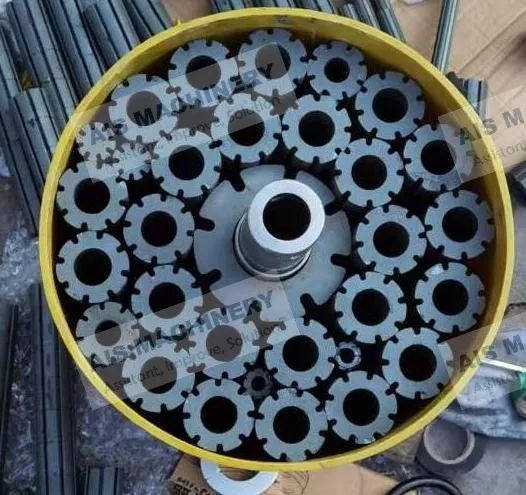
Nature: A complete device composed of ferrite rods + water-cooling tube + protective sleeve.
-
Function: Installed inside the tube at the welding position of the tube mill, it prevents HF current from spreading, forcing the current to concentrate at the seam edges.
-
Components:
-
Inside: Ferrite rod (core material)
-
Shell: Stainless steel or fiberglass sleeve (for protection)
-
Cooling: Copper or stainless-steel tube for water-cooling
-
-
Features:
-
An application product of ferrite rods
-
Can be customized according to tube size, frequency, and power
-
Performance and lifetime depend directly on ferrite quality
-
3. Summary of Differences
| Comparison | Ferrite Rod | Impeder |
|---|---|---|
| Definition | A magnetic material (Ferrite), a component | A complete device used in tube mills |
| Function | Concentrates magnetic field, increases inductance | Concentrates HF current at the seam, improves welding efficiency |
| Form | Rod, tube, block | Assembly containing ferrite rod |
| Directly usable | Cannot be directly used in tube mills | Can be directly installed and used |
| Relationship | Core raw material of impeder | Application product of magnetic rods |
👉 In short:
-
Ferrite rod is the “raw material”
-
Impeder is the “finished tool”
The ferrite rod is placed inside the impeder, which is then used in the tube mill.

Related Products





Related News

2026-11-02 02:23:25
ERW Pipe Mill for Sale: Buyer FAQs for a 76 mm Line
Review the 21.3 mm to 76 mm range, materials, equipment, speed, power, cutting methods, and production controls for an ERW pipe mill for sale.

2026-10-29 00:44:48
High-Speed Steel Coil Slitting Line FAQ: Specifications, Ordering and Support Questions
Get direct answers about High-Speed Steel Coil Slitting Line specifications, material compatibility, component layout, process steps, quality standards, and after-sales support from HEBEI AIS MACHINERY EQUIPMENT CO.,LTD.

2026-10-28 00:06:34
Learn the key working requirements and integration criteria for selecting a steel pipe making machine manufacturer. Covers diameter range, wall thickness, strip grade, HF welding power, footprint, and electrical supply using the 10inch 273mm ERW Pipe Making Machine from HEBEI AIS MACHINERY EQUIPMENT CO.,LTD.

2026-10-28 00:05:55
Choosing a Flying Cold Saw: Working Requirements and Integration Fit
Learn the key selection criteria for a flying cold saw — pipe diameter, line speed, cut precision, blade type, and PLC integration — to find the right cold cutting flying saw machine for your ERW tube mill.

2026-10-28 00:05:28
Evaluate whether the GGP 100kw Solid State High Frequency Induction Heating Welding Machine fits your ERW pipe production line. This guide covers power requirements, cooling infrastructure, electrical supply, and control integration criteria.

2026-10-28 00:04:41
Choosing Quick-Change System for Forming & Sizing Section: Application Fit and Specification Checks
Learn the key selection criteria for a Quick-Change System for Forming & Sizing Section in ERW tube mills — covering changeover frequency, cassette structure, pneumatic couplings, and application scope for structural, automotive, and export tube production.

2026-10-23 17:54:55
Compare a steel pipe seam annealing machine and a pipe threading machine: function, published ranges, PLC/HMI and CNC controls, operating steps and maintenance.

2026-10-04 16:13:15
HEBEI AIS MACHINERY at Tube & Wire Shanghai 2026 | Tube Mill Solutions
HEBEI AIS MACHINERY participated in Tube & Wire Shanghai 2026, meeting new and long-term customers to discuss ERW tube mills, steel processing equipment, new projects, and future cooperation.
Send a Message
Dear customer, thank you for your attention! We provide high-quality machinery and equipment and look forward to your orders. Please inform us of your needs and we will respond quickly!
 English
 Albanian
 Arabic
 French
 German
 Indonesian
 Italian
 Japanese
 Kazakh
 Korean
 Latin
 Macedonian
 Portuguese
 Russian
 Spanish
 Thai
 Turkish
 Ukrainian
 Uzbek